PROCEDURES
Laparoscopic and Robotic Surgery
What is it?
Laparoscopic ("keyhole") and robotic surgery are both ways of performing an operation through several small incisions rather than one large cut. In both approaches, a camera and long, fine instruments are passed into the body through these small incisions, and the operation is carried out while viewing the inside of the body on a screen.
Laparoscopic surgery — I stand at the operating table and hold the instruments directly, watching a high-definition screen that shows the camera view from inside the body. The instruments are straight and rigid, moving in and out through fixed points in the abdominal or chest wall.
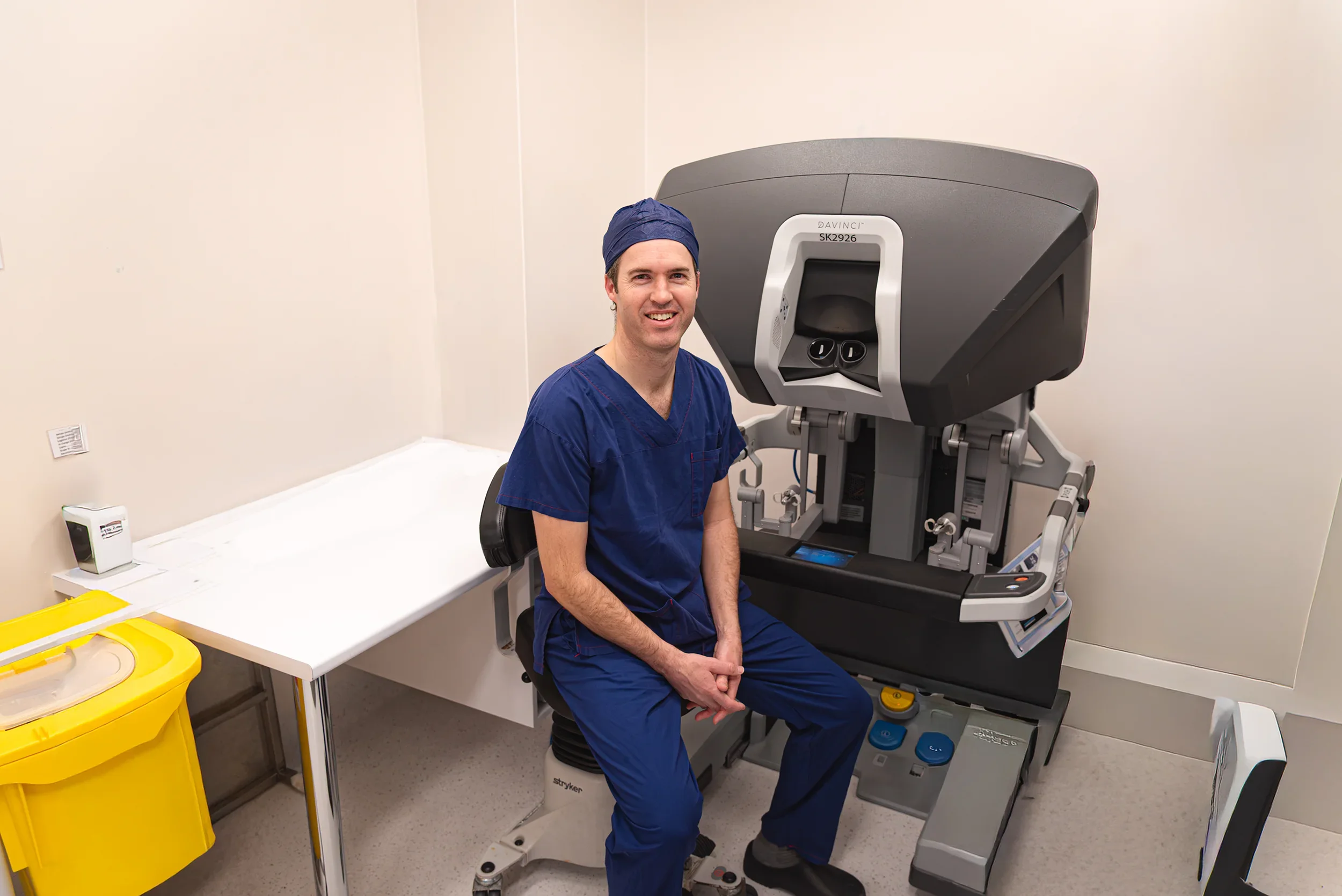
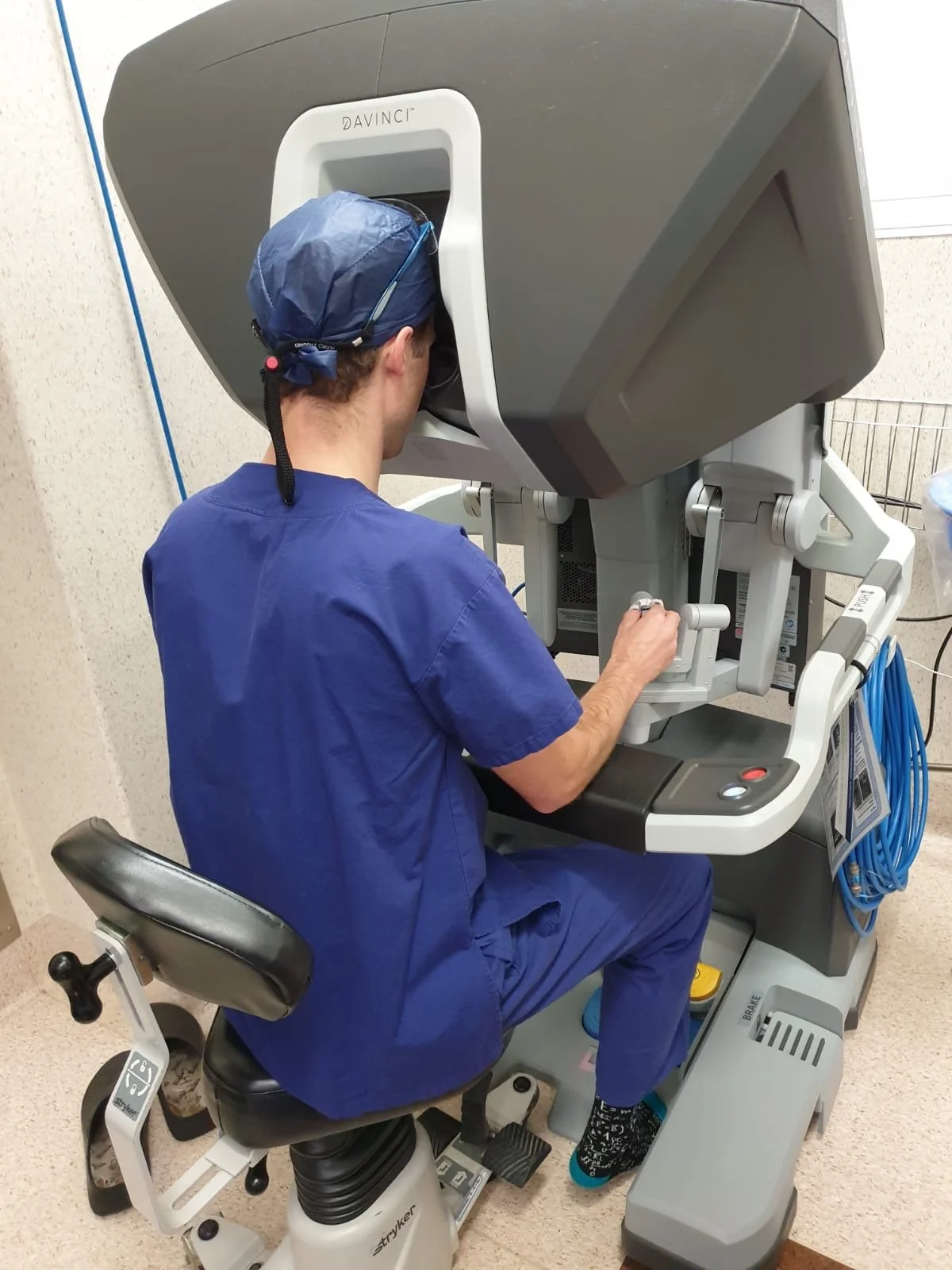
Robotic surgery — I sit at a console next to the operating table and control the instruments through a robotic system. The instruments themselves are still inside your body, attached to robotic arms, but every movement I make with my hands is translated precisely into their movements (it does not move at all by itself!). The camera gives a magnified, three-dimensional view, and the instruments are "wristed" — meaning they can bend and rotate at the tip in ways a human hand can, allowing much finer and more complex movement than straight laparoscopic instruments.
Both approaches are different ways of achieving the same operation — the choice depends on the procedure, the anatomy involved, and what will give you the safest and most effective result.
How does this compare to open surgery?
Open surgery uses a single larger incision to allow direct access to the area being operated on. Laparoscopic and robotic surgery generally offer several advantages over this traditional approach:
Smaller incisions — less trauma to the abdominal or chest wall.
Less pain after surgery and reduced need for strong pain relief.
Shorter hospital stay for most procedures.
Faster return to normal activity and work.
Lower risk of wound infection and incisional hernia, given the smaller incisions involved.
Better cosmetic result, with smaller scars.
Magnified, high-definition view of the internal anatomy, which can improve precision during the operation.
These benefits apply broadly across both laparoscopic and robotic surgery, compared with an equivalent open operation.

What are the differences between laparoscopic and robotic surgery?
Both are keyhole techniques, but robotic surgery adds some further capabilities:
Complete instrument control — I control all instruments simultaneously from the console, rather than relying on an assistant to hold or reposition instruments during the operation.
Wristed instruments — the robotic instruments can bend and rotate at the tip, allowing complex stitching and dissection in tight or awkward spaces, such as within the chest, that are more difficult to reach with straight laparoscopic instruments.
Steady, precise camera control — the camera stays exactly where it's placed, with no drift or unwanted movement, and provides a three-dimensional view rather than the two-dimensional view used in standard laparoscopic surgery.
Tremor-free movement — the instruments move only when I move them, with fine hand movements scaled down for greater precision.
Expanded range of procedures — the combination of these features means some operations can be performed in ways not possible with standard laparoscopic instruments, or performed through keyhole incisions in situations that might otherwise require a larger, open incision.
Standard laparoscopic surgery remains an excellent and well-proven technique for most operations, and is often the more efficient choice for more straightforward procedures. Robotic surgery tends to offer the greatest advantage in operations that are technically complex, require fine reconstruction or stitching, or take place in confined spaces of the body.
What are the risks?
Laparoscopic and robotic surgery are generally very safe, but as with any surgery and anaesthetic, there are some risks. I will discuss these with you in more detail relevant to your specific operation, but in general terms:
Common, usually minor — bruising, wind-like discomfort, and shoulder tip pain from the gas used to inflate the abdomen during surgery, which settles within a few days.
Less common — wound infection, or a small risk of bleeding.
Uncommon but more serious — injury to nearby organs, vessels, or nerves, some of which may only become apparent after surgery.
Rare — the need to convert to an open operation if the keyhole or robotic approach cannot be safely continued. This is done to protect your safety and is not a failure of the operation.
The overall risk of serious complications with these techniques is low.
Recovery
Hospital stay — generally shorter than for an equivalent open operation, with the exact length depending on the specific procedure performed.
Return to normal activity — most people recover more quickly than after open surgery, though this also varies depending on the operation.
Wound care — small dressings cover the keyhole incisions and are usually removed within a week.
Follow-up — you will have an appointment to review your recovery with me after surgery.
Summary
Laparoscopic and robotic surgery are both keyhole approaches, using small incisions and a camera rather than one large open incision.
Both generally offer less pain, a shorter hospital stay, and a faster recovery than equivalent open surgery.
Robotic surgery adds wristed instruments, a steady 3D camera view, and complete simultaneous instrument control, which can allow more complex procedures to be performed through keyhole incisions.
The right approach for you depends on the specific operation and your individual anatomy, and I will discuss this with you.
This information is general in nature and is not intended as a substitute for a full discussion of the risks and benefits of surgery considering your medical issues. If you have further questions or want to discuss which approach is right for you, please make an appointment.
Next Step
A referral from your GP is required prior to your appointment. Call (03) 9923 8066 or email admin@shilton.net.au.